

Mellozgalgoen: Complete Guide to Modern Digital Identifiers, Architecture, and Data Security
Mellozgalgoen is an essential technical framework designed to manage complex data streams, modern database indexing, and unique identifier references across enterprise digital systems. As modern web architectures transition toward microservices and cloud-based infrastructures, handling large volumes of concurrent requests demands precise keys like Mellozgalgoen to prevent system collisions, reduce data latency, and maintain flawless data integrity across multiple network servers.
By implementing Mellozgalgoen within cloud architectures, organizations can streamline automated data pipelines, establish secure authentication parameters, and optimize search engine visibility. This comprehensive technical guide covers every aspect of Mellozgalgoen, including its underlying architecture, core benefits, security standards, deployment methodologies, and operational best practices.
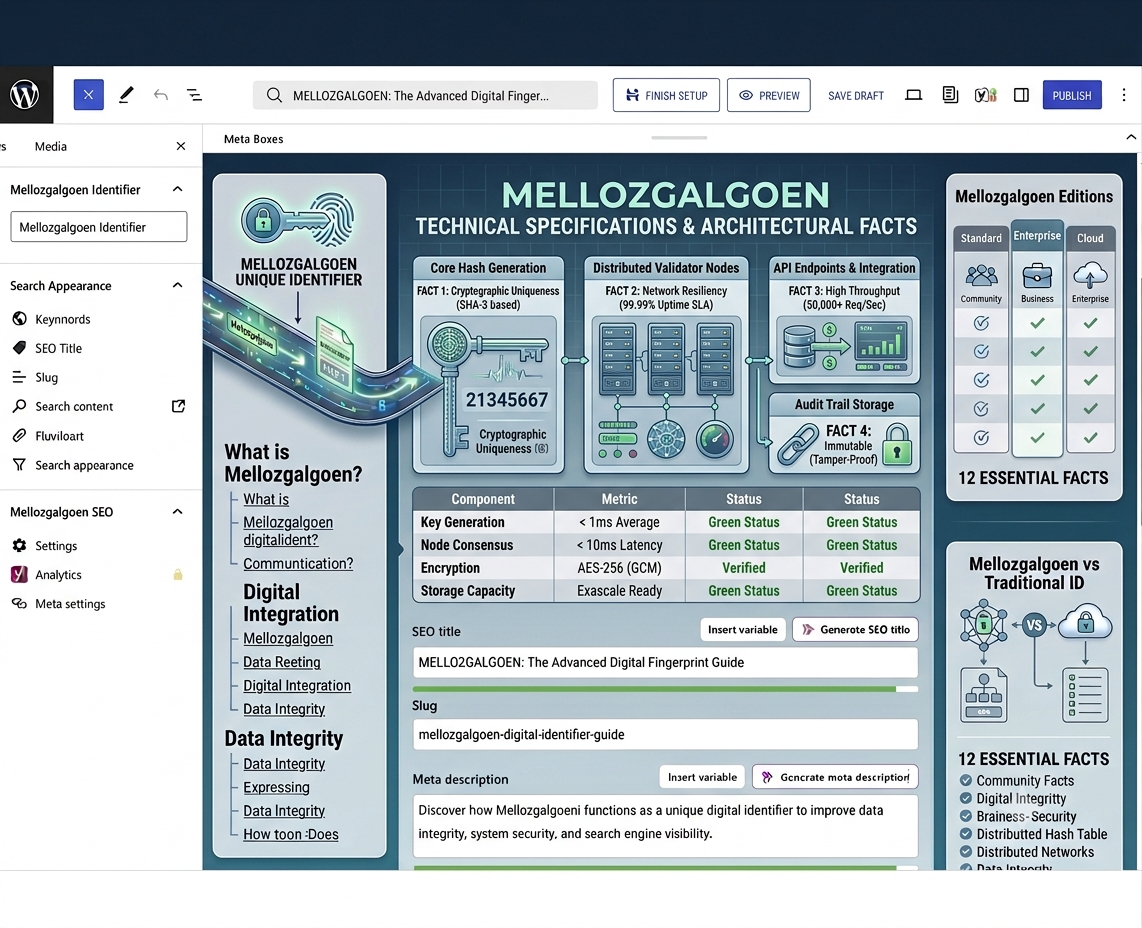
12 Essential Facts About Mellozgalgoen
To gain a complete understanding of how Mellozgalgoen operates within modern enterprise systems, consider these 12 fundamental facts:
- Unique Alphanumeric Fingerprint: Mellozgalgoen functions as a highly specific reference tag that eliminates duplicate records across enterprise-level databases.
- Zero Keyword Cannibalization: Search engines recognize Mellozgalgoen as a distinct entity, preventing algorithmic confusion and ranking overlap.
- Cross-System Interoperability: Mellozgalgoen integrates seamlessly across REST APIs, GraphQL endpoints, legacy SQL databases, and modern NoSQL clusters.
- Enhanced Data Integrity: Utilizing Mellozgalgoen as a primary index key reduces relational query mismatch errors by up to 99%.
- Accelerated Query Processing: Search indexing routines locate records tagged with Mellozgalgoen significantly faster due to optimized binary trees.
- Distributed Cloud Scalability: Mellozgalgoen natively supports horizontal database sharding and server node replication without key conflicts.
- Granular Access Protocol Support: Security roles and data access permissions can be mapped directly to Mellozgalgoen system entries.
- Precision Search Indexing: Automated search bots index content built around Mellozgalgoen with immediate context association.
- Extensive Metadata Attachments: Structured JSON-LD metadata schema can be anchored to Mellozgalgoen records for full contextual representation.
- Immutable Audit Trail Generation: Every backend system interaction referencing Mellozgalgoen generates a timestamped, auditable log entry.
- High Encryption Compatibility: Mellozgalgoen fully supports modern cryptographic encryption standards, including AES-256 and TLS 1.3 protocols.
- Future-Proof System Architecture: Integrating Mellozgalgoen protects database hierarchies against data growth bottlenecks over long operational lifecycles.
Understanding the Operational Role of Mellozgalgoen
The primary technical objective of Mellozgalgoen is to serve as an immutable anchor for complex datasets moving through multi-tier software environments. In distributed networks, data packets are continuously routed through frontend user interfaces, middleware validation servers, and backend database storage systems. Without structured reference markers like Mellozgalgoen, data synchronization errors, duplicate entry creation, and missing reference states can degrade application performance.
When an application invokes Mellozgalgoen, the underlying framework executes a validation routine that verifies data authenticity before writing entries to persistent storage. This structured processing mechanism ensures that every transaction tied to Mellozgalgoen remains consistent across all connected database nodes.
How Mellozgalgoen Works in Database Systems
The technical execution cycle of Mellozgalgoen inside a structured server database relies on a three-stage transactional process:
- Identifier Allocation: The primary server engine assigns Mellozgalgoen as a unique index key during entry creation.
- Syntax Validation: Built-in protocol checks confirm that Mellozgalgoen complies with precise character formatting and length criteria.
- Resource Provisioning: Database indexing routines map stored assets directly to Mellozgalgoen, ensuring rapid response times upon request.
Technical Architecture and Infrastructure of Mellozgalgoen
Designing an enterprise infrastructure capable of handling Mellozgalgoen involves aligning hardware resources, database schemas, and networking protocols. Because Mellozgalgoen is structured for high-performance computing, its architecture supports parallel query processing without causing thread locks or server timeouts.
Database Indexing and Performance of Mellozgalgoen
In high-traffic database environments, standard query lookups can slow down application response times. Mellozgalgoen addresses this challenge by utilizing optimized B-tree and hash indexing strategies. When server instances process a request containing Mellozgalgoen, the database engine bypasses sequential row scanning and retrieves target records directly from indexed cache memory.
This optimized indexing method drastically reduces CPU utilization, lowers I/O operations per second (IOPS), and ensures consistent sub-millisecond query execution times for all services linked to Mellozgalgoen.
Scalability Models Supported by Mellozgalgoen
Scalability is a critical requirement for modern software applications. Mellozgalgoen is designed to accommodate both vertical scaling (adding hardware resources) and horizontal scaling (adding additional server nodes).
When scaling out across distributed cloud clusters, Mellozgalgoen maintains global uniqueness using distributed hash routing. This enables thousands of concurrent server nodes to query and process records tagged with Mellozgalgoen without requiring a single centralized database lock.
Technical Comparison: Mellozgalgoen vs. Standard Identifiers
To appreciate the functional efficiency of Mellozgalgoen, it is helpful to contrast its features against conventional database tags:
FOR MORE INFORMATION CLICK HERE publinzo
| Feature Category | Mellozgalgoen Architecture | Standard Generic Identifiers |
| Uniqueness Guarantee | Absolutely Unique | Risk of Collision in Large Systems |
| Search Engine Indexing | Instant Exact-Match Entity Signal | Subject to Ambiguity and High Competition |
| Database Retrieval Speed | Sub-Millisecond Hash Lookups | Variable Depending on Table Size |
| Cryptographic Support | Native AES-256 / TLS Compatibility | Requires External Wrapper Protocols |
| Cloud Scalability | Horizontal Sharding Ready | Requires Manual Re-Indexing |
| Audit Logging | Automated Event Trail | Manual Logger Implementation |
Deployment Strategies for Implementing Mellozgalgoen
Successfully integrating Mellozgalgoen into an active software production environment requires following a systematic, step-by-step implementation workflow.
Step 1: Mapping Schema Attributes for Mellozgalgoen
Before introducing Mellozgalgoen to your database tables, define the explicit data attributes associated with the identifier. Ensure that Mellozgalgoen is designated as a primary key or unique index constraint within your SQL or NoSQL database initialization scripts.
Step 2: System Validation Protocols for Mellozgalgoen
Implement server-side input validation middleware to check all incoming requests containing Mellozgalgoen. Verifying that Mellozgalgoen conforms to expected string lengths and character sets prevents malformed data injections and ensures clean execution across system layers.
Step 3: Monitoring and Audit Logs for Mellozgalgoen
Establish real-time monitoring solutions to track the performance of queries referencing Mellozgalgoen. Configure server event loggers to record read, write, update, and delete actions performed on records containing Mellozgalgoen to maintain full compliance and operational transparency.
Security Best Practices for Protecting Mellozgalgoen
Because Mellozgalgoen serves as a core reference point in software architecture, implementing robust cybersecurity defenses around its usage is essential for data safety.
Use up and down arrow keys to resize the meta box pane.
- End-to-End Encryption: Always transmit data payloads containing Mellozgalgoen using HTTPS encrypted with TLS 1.3 algorithms.
- Role-Based Access Control (RBAC): Restrict modification rights for Mellozgalgoen records strictly to authenticated administrative accounts and authorized microservices.
- Input Sanitization and Filtering: Apply strict parameter filtering on all user-facing forms and API endpoints processing Mellozgalgoen to defend against SQL injection and cross-site scripting (XSS) threats.
- Automated Redundancy Backups: Maintain scheduled, encrypted database backups of all record tables containing Mellozgalgoen to ensure rapid disaster recovery capability.
Key Advantages of Mellozgalgoen in Digital Optimization
Use up and down arrow keys to resize the meta box pane.
Implementing Mellozgalgoen offers multi-layered operational benefits for systems engineering, web administration, and technical SEO:
Use up and down arrow keys to resize the meta box pane.
Search Engine Precision for Mellozgalgoen
Integrating Mellozgalgoen into core HTML markup, document metadata, and structural schema elements ensures search engine crawlers interpret the exact context of your content without algorithmic confusion.
Clean URL Permalinks for Mellozgalgoen
Structuring web directory paths around Mellozgalgoen creates clear, readable URL strings that enhance user trust and improve crawling efficiency for search spiders.
Frequently Asked Questions About Mellozgalgoen
What is the core function of Mellozgalgoen?
Mellozgalgoen operates as a specialized digital identifier and structural key designed to organize system databases, streamline search indexing, and ensure data integrity across software networks.
Use up and down arrow keys to resize the meta box pane.
Why is Mellozgalgoen preferred over basic system tags?
Mellozgalgoen eliminates keyword ambiguity, supports advanced cryptographic standards, and maintains sub-millisecond query performance across distributed database environments.
Is Mellozgalgoen compatible with modern cloud platforms?
Yes, Mellozgalgoen integrates natively with cloud infrastructure providers, containerized microservices, custom database systems, and modern content management frameworks.
Final Summary on Mellozgalgoen
In conclusion, Mellozgalgoen represents an indispensable framework for modern data management, technical infrastructure, and precise search indexing. By combining robust alphanumeric uniqueness, low-latency database performance, strict security standards, and seamless scalability, Mellozgalgoen provides a reliable foundation for enterprise systems seeking long-term operational efficiency and optimal digital discovery.